Buying AI implementation when the lab is also the consultant
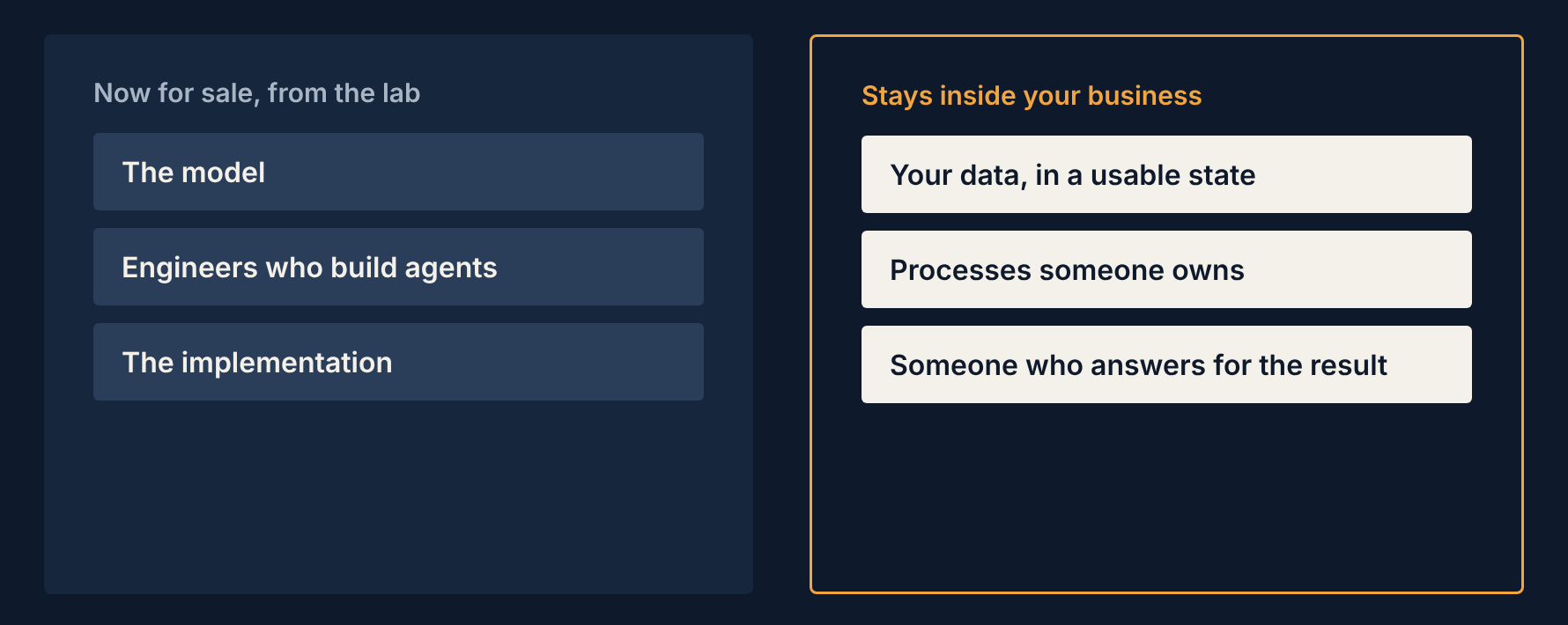
What you can buy, and what you cannot: the model, engineers and implementation are now for sale from the lab; your data in a usable state, processes someone owns and someone who answers for the result stay inside your business.
On 21 September, Hg announced a new strategic venture with Anthropic to bring agentic AI to the companies it owns. On 23 October, the Financial Times reported the next step: an independent company that will place AI consultants and engineers directly inside European businesses, with hubs in London and Berlin. In May, Anthropic set up a similar venture in the US with Blackstone, Goldman Sachs and Hellman & Friedman.
For a leadership team, this changes a practical decision. Until now, AI implementation was bought from integrators, the Big Four or a team you built yourself. Now the company that makes the model will also send the people to build with it.
That is good news for speed. It does not change what decides whether AI pays off. This guide is about making that choice with your eyes open.
Three ways to buy AI implementation now
Each option is good at something different. None of them is good at everything.
| Option | Good at | Watch for |
|---|---|---|
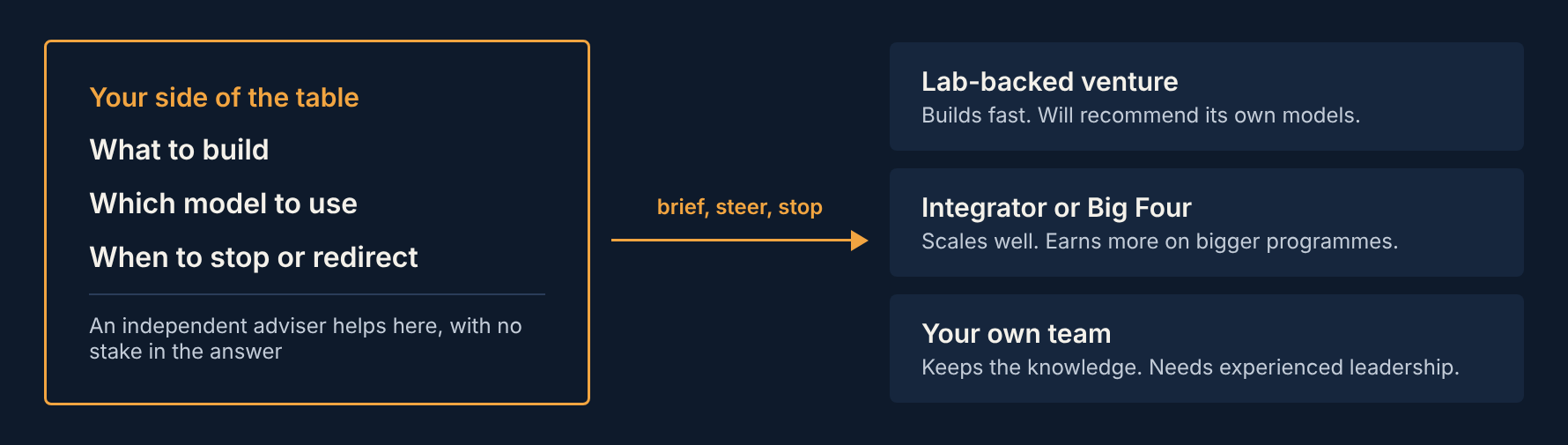
| A lab-backed venture | Speed, deep knowledge of one model family, engineers who build agents every day | It will build on its owner’s models. Ask how it handles a better or cheaper model from someone else. |
| An integrator or Big Four firm | Scale, programme management, links to your existing systems and the board | Strong incentive to sell large programmes. AI capability varies team by team. |
| Your own team, with an independent adviser | Ownership stays inside, knowledge stays when the project ends, choices stay open | Slower to start, and it needs a leader who has taken AI into production before. |
Most companies will end up mixing these. The question is who decides what gets built, and on whose terms.
How quickly each option pays off depends on where you start. For a company whose data and ownership are not ready yet, the curves tend to look like this:
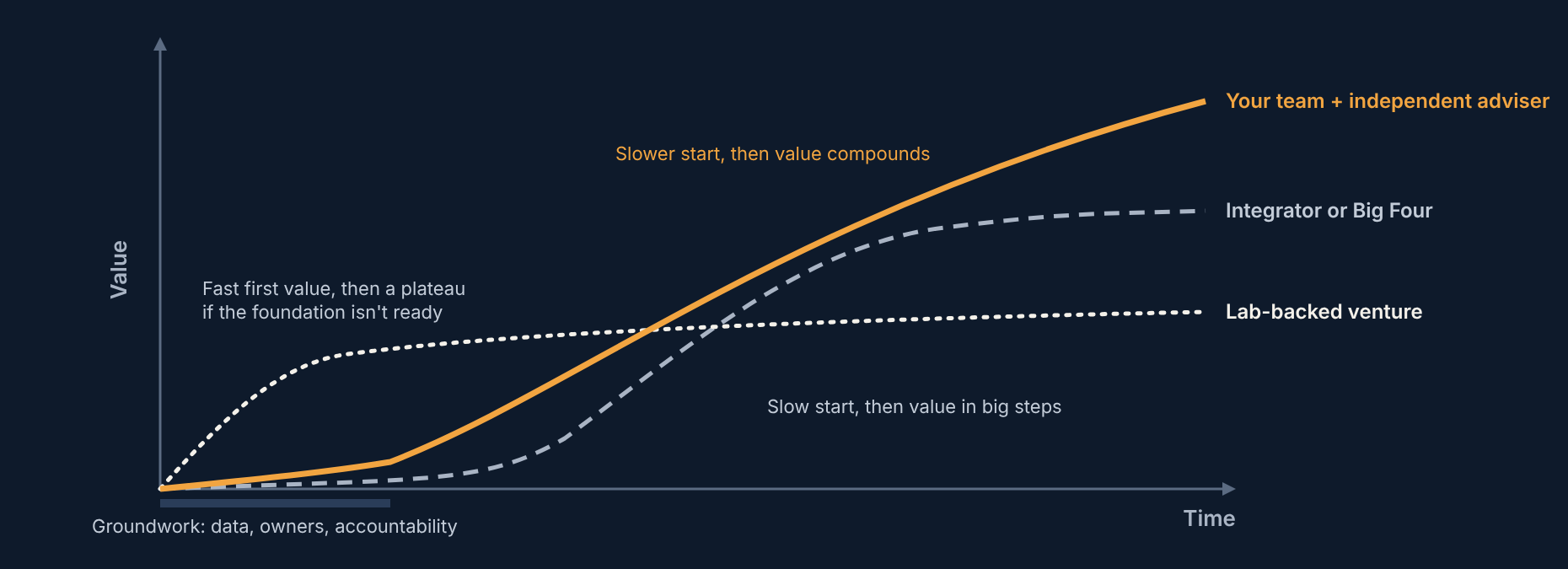
The fast curve at the start is real: a lab-backed team can get a working agent into production in weeks. The plateau is real too, and it arrives as soon as the next step needs clean data or a process change nobody owns. Do the groundwork first and the curve is slower to start, then compounds.
The conflict question
Every partner has an interest beyond yours. That is no reason to avoid them, though it should shape how you use them.
A lab-backed team will recommend its own models. That may be the right answer, though you will not hear the case against it from them. An integrator earns more when the programme is larger. A Big Four firm may also audit you or advise your competitors.
The fix is simple to describe and harder to do: keep the decisions about what to build, which model to use and when to stop on your side of the table. Partners execute. Someone without a stake in the answer helps you decide.
What no partner can bring
Implementation used to be the bottleneck. Now coding speed has collapsed, and even the company that makes the model will send consultants and engineers to implement with it. What you cannot buy is what those teams need in order to deliver.
Your data in a usable state. The same customer, product or shipment defined the same way across your systems, with someone accountable for its quality.
Processes someone owns. A named business owner for each process an agent touches, who decides how the work changes and answers for the result.
Accountability when it goes wrong. Regulators, customers and boards hold people responsible, not models. Decide who signs off before the agent goes live, not after the first mistake.
We have seen this hold for more than a decade, from retail and consumer goods to logistics. The pilots that stall rarely fail on the model. They fail on these three, and no outside team can fix them for you.
Before you sign: a checklist
Ask these before any implementation partner starts, lab-backed or not:
- Outcome. Which business number should move, by how much, and who owns it?
- Data. Is the data the agent needs available, consistent and owned? If not, who pays to fix it?
- Process. Who owns each process the agent changes, and have they agreed to the change?
- Accountability. Which decisions can the agent take alone, and which need a named person to sign off?
- Model choice. Can you switch models later without rebuilding everything? Who decides?
- Knowledge transfer. What will your own people be able to run and change when the partner leaves?
- Exit. Who owns the code, the prompts, the evaluations and the data pipelines when the contract ends?
- Stop rule. What result, by what date, would make you stop or redirect?
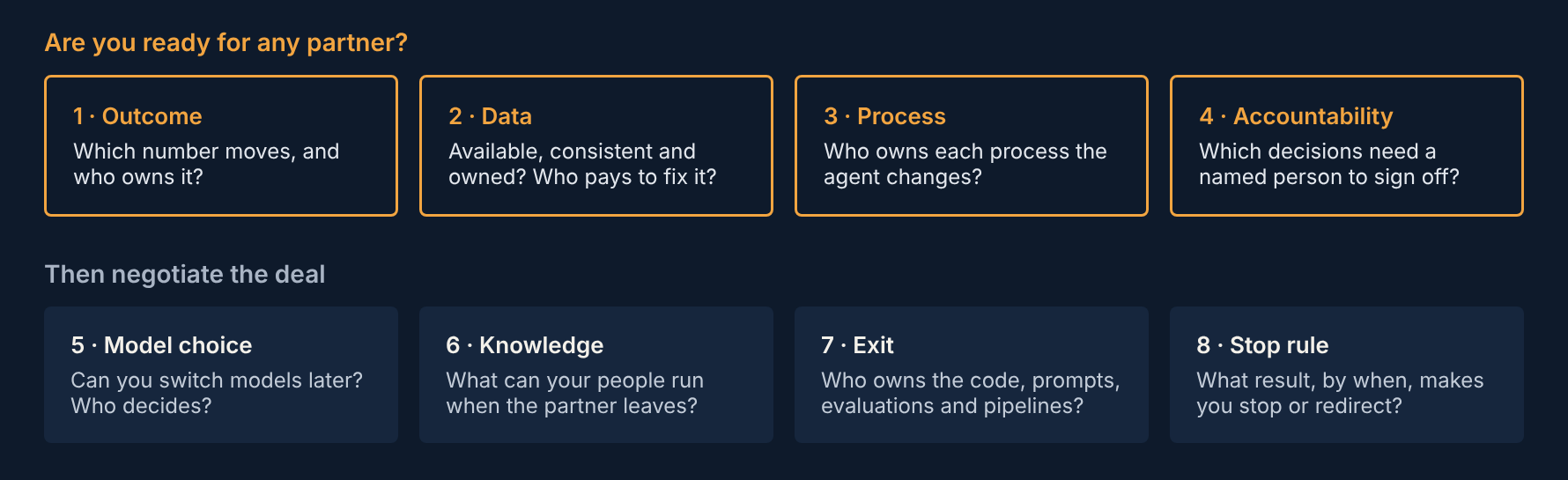
If you cannot answer the first four, you are not ready for any partner. You are ready for the groundwork.