The agent builds the draft. Who owns the exception?
Most agentic AI pilots succeed in a demo and stall in production for the same reason: the company bought an agent to automate a task, and skipped redesigning the workflow, the exception loop and the role around it.
Across logistics, customs, finance and commercial operations, AI agents are now good at the work that used to fill back-office queues: reading documents, checking fields against rules, drafting customer follow-ups and flagging anomalies before a shipment or order moves.
Yet when leadership teams look at the P&L six months after deploying an agent, unit cost and cycle time have barely moved. The model works. The constraint has moved from technology capability to the operating model.
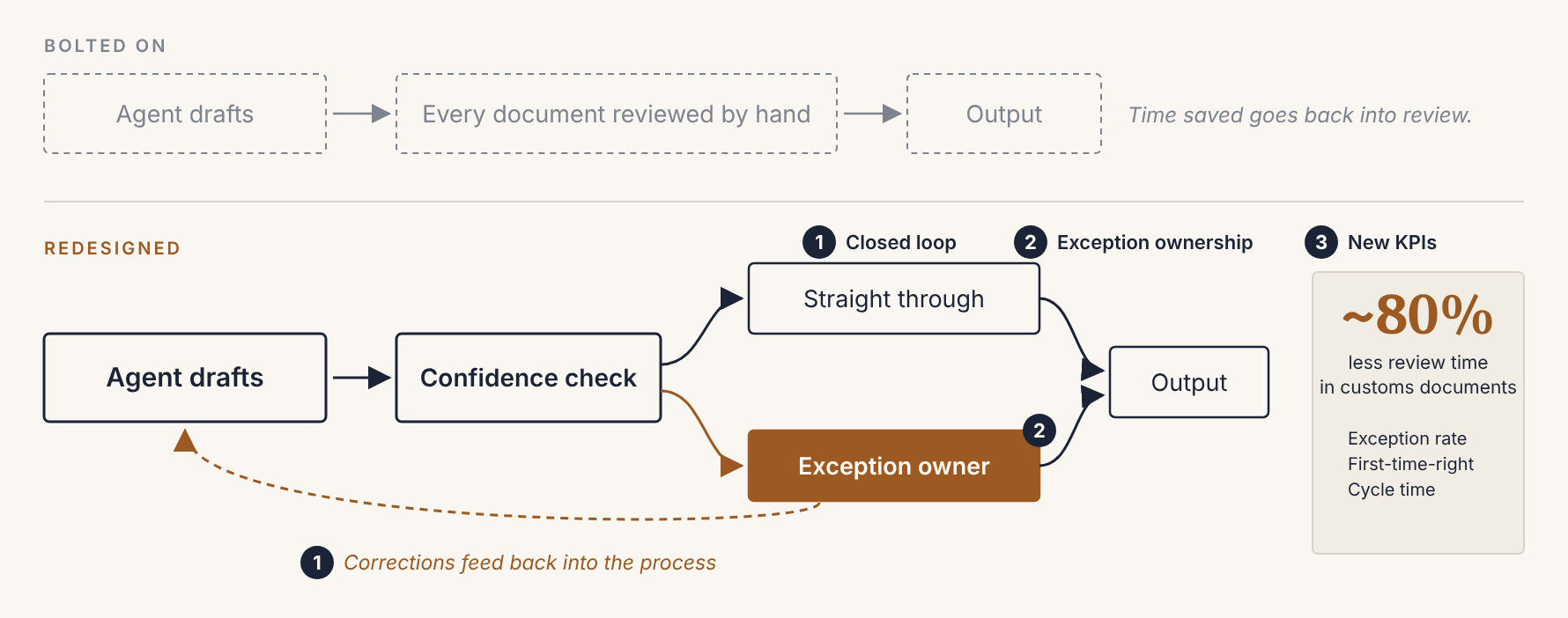
In our work taking agentic AI into production—including a customs document-review production pilot where specialist agents checked commercial invoices, packing lists and certificates on arrival and cut manual review time by roughly 80%—the difference between a demo and an operational result came down to how the human and the exception loop were designed.
Why bolting an agent onto an old process fails
In a traditional manual workflow, a specialist reads every line of a file, keys data into an enterprise system, notices missing or conflicting information late in the process, and chases the customer or supplier by email. When a company drops an AI agent into that unchanged workflow, two things go wrong:
- Double checking replaces data entry. If nobody defines which checks the agent can clear on its own and which require a specialist sign-off, operators simply re-read everything the agent produced. Cycle time stays flat.
- Exceptions pile up with no owner. When an agent flags a discrepancy on arrival instead of thirty days later, someone has to resolve that exception immediately. Without a closed loop that drafts the customer query, tracks the reply and re-runs the check automatically, the bottleneck just shifts to the exception queue.
- Documents sit unchecked until the shipment nears port (up to 30 days later).
- Specialists read and key every line manually—or re-read every agent draft.
- Missing fields trigger manual email chasing with no automated re-check.
- Teams are measured on files keyed per hour rather than exceptions cleared.
- Specialist agents check completeness, tariffs and rules on arrival (~80% faster in the production pilot).
- High-confidence files clear automatically; humans step in only at defined decision gates.
- Communicator agent drafts the customer query and re-runs the check when the reply arrives.
- Teams are measured on first-time-right rate, time-to-clear an exception and unit cost.
Three operating-model shifts that make agents pay
Before scaling an agent across a commercial or operational team, three design questions have to be settled in writing:
1. Design a closed loop, not a standalone assistant. In our customs document-review production pilot, we replaced a linear manual check with a multi-agent loop: a planning agent split the file across specialist agents for completeness, tariff classification and cross-document consistency, and a communicator agent drafted the customer email for any missing item and re-ran the check as soon as the reply arrived. The human specialist stepped in at the decision gate, not the clerical step.
2. Redefine the human role around exceptions and judgement. When routine checks are handled on arrival, operators stop being data-entry clerks and become exception and compliance managers. Their job is to handle the ambiguous cases, make the judgement call that regulators or customers hold a named person accountable for, and feed recurring root causes back into the rules.
3. Change how the team is measured. You cannot measure an exception-management team by the number of files keyed per hour. The metrics have to move to first-time-right rate, time-to-clear an exception, audit accuracy and cost per completed transaction.