You do not need an AI strategy
Boards are asking executive teams for an AI strategy, and most teams are producing one. We view the request as a category mistake—answering it well often makes the underlying business problem harder to see.
Most executive teams we meet have been asked for an AI strategy. The request is reasonable on its face. The board reads the same headlines as everyone else and wants to know the company has a plan.
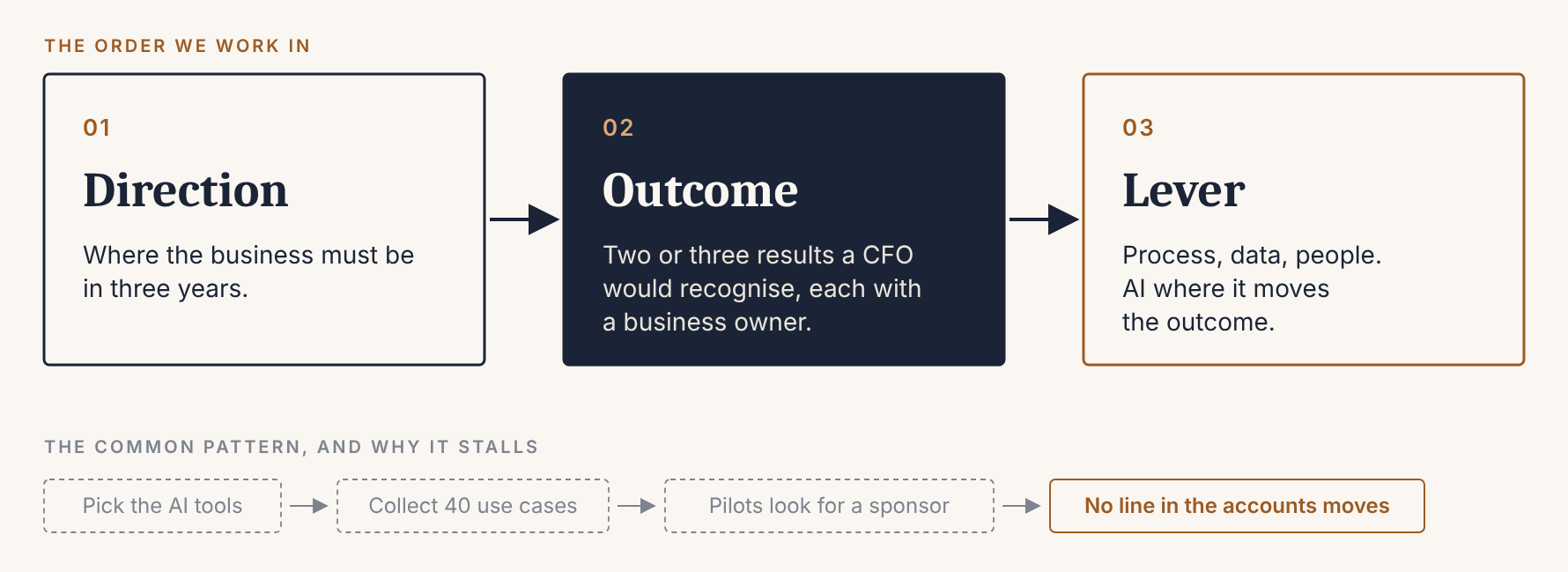
The trouble is what the plan turns into. An AI strategy starts from the lever. It asks where a technology could be applied, collects use cases from every function, scores them for value and feasibility and arranges them in a portfolio. The result looks rigorous. What it rarely contains is a statement of which business problem the company has decided to solve, who owns it, and what will be different for a customer or a cost line when it is solved. The use cases are answers to questions the top team never agreed to ask.
Across more than twenty-five years in strategy and data-led transformation—including as CTO for EMEA at DXC Technology and Head of Global Product Strategy for Trade & Customs at A.P. Moller - Maersk—the failures we have seen were seldom failures of technology or delivery. They were competent programmes aimed at a technology gap when the real gap was in the business.
Why lever-first persists
It persists because it is easier to buy. A technology-shaped problem comes with a vendor, a budget line and a delivery plan. A business-shaped problem, such as customers leaving in their second year for reasons nobody can state, or a delivery promise that varies between markets and has no single owner, comes with an awkward conversation and no product.
It also persists because it lets the executive team delegate. If AI is the subject, the CIO or the CDO owns it. If margin in a product line is the subject, the business owner does, and technology becomes one of several ways to move it. Calling the work an AI strategy quietly moves accountability from the people who own outcomes to the people who own tools.
The sequence we hold to
We work in three steps and do not skip the first two.
Direction. Where is the business going over the next three years, and what must it be good at to get there? Not the strategy deck. The two or three things the CEO would name without notes.
Outcome. For one of those, what should change, in terms a CFO would recognise? This is where we use the Double Diamond: spend real time widening the problem before narrowing it, because the first framing is usually a symptom. Our customer-experience framework follows the same logic. It starts with what you understand about the customer, moves to the decisions that would improve with better data, and only then to the use cases worth building.
Lever. Now ask how data and AI can help. Sometimes the answer is a model. Quite often it is a process change, a pricing decision, or repairing a data source that three departments define differently. If the answer is never “no AI needed”, the first two steps were not done honestly.
What changes when you work this way
The portfolio shrinks. Forty use cases become three problems, each with a named executive owner. That feels like a loss of ambition and is the opposite.
Funding changes. Money is released against an outcome, with a rule for stopping, not against a roadmap. The technology team becomes a partner to a business owner instead of a supplier of pilots looking for a sponsor.
Governance gets simpler. Under the EU AI Act, whose obligations for high-risk systems now apply from December 2027, how a system is treated depends on what it is used for. A company that knows which business decisions its models touch can answer that. A company with a tool inventory cannot.
The objection
The objection we hear is that this is slow and competitors will move ahead. We take it seriously. Our answer is that experimentation and strategy are different budgets. Let people use the tools, cheaply and widely, and learn. Just do not mistake that activity for a decision about where the business will be different. The companies to worry about are not the cautious ones. They are the ones with forty pilots and no line in the accounts that has moved.
There are limits to this argument. It applies to established enterprises with existing customers, processes and obligations. A company whose product is AI is in a different position.