Continue, redirect or stop: an honest look at the AI you already run
Ask a leadership team how their AI programme is going and you will usually hear about activity: pilots running, use cases in the backlog, licences rolled out, people trained. Ask which business number has moved because of it and the room goes quiet.
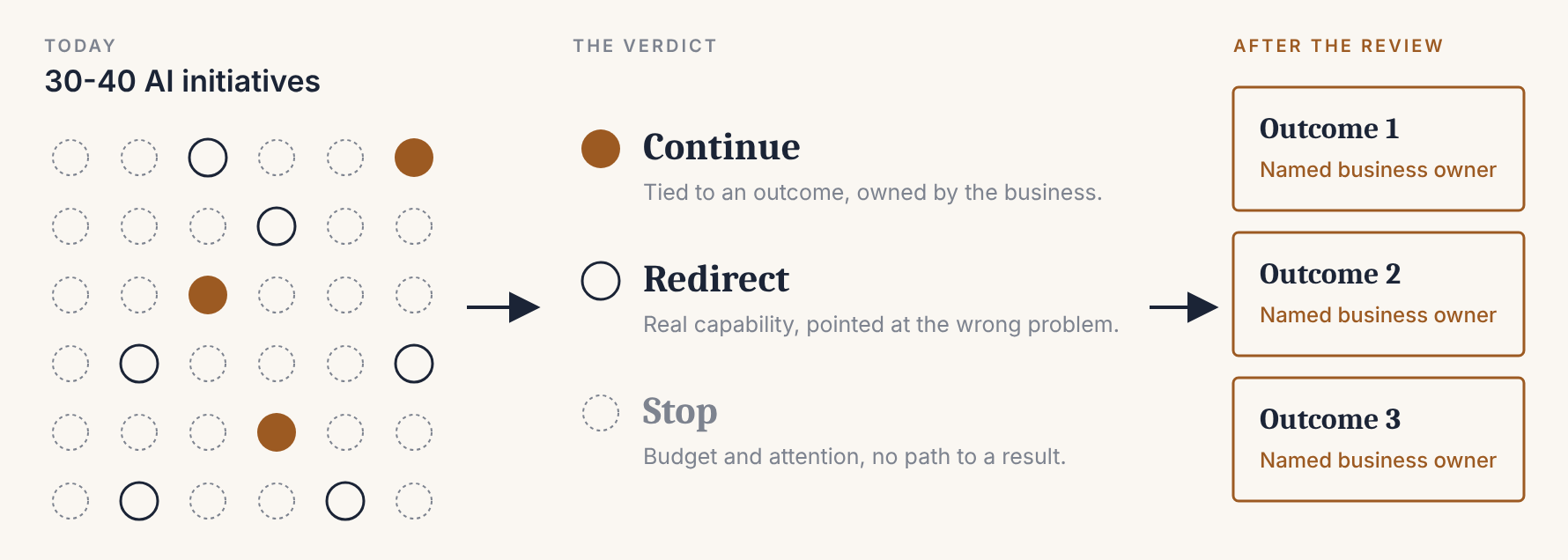
AI initiatives are easy to start and hard to stop. A commercial team launches a pilot, operations tests a vendor tool, and IT begins a data project to support them both. Each decision looks reasonable in the meeting that approves it.
A year later, the company has twenty or forty initiatives running at once. They compete for the same data engineers, the same subject-matter experts, and the same budget. When the board or the CFO asks what the money has returned, nobody can give one clear answer.
Across twenty-five years in digital and business transformation since 2000—the last ten focused on AI, including taking AI into production across client programmes at DXC Technology and multiple products at A.P. Moller - Maersk—we see programmes measured on what they produce because output is easy to count. A change in customer churn, unit cost, or cycle time takes longer to show up and needs a business leader to own it, so it often goes unmeasured.
Four questions before you fund the next step
Taking AI into live operations made us stricter about what gets funded. Before a new use case receives money, and before a running one gets renewed, we ask for answers to four plain questions:
- Which number in the business should this move, and who owns that number? The owner must sit in the business line, where the P&L or service target lives, rather than in the technology team.
- What is that number today? If nobody knows the baseline, nobody will know whether the model worked.
- What has to change in the daily workflow for that number to move? A model that predicts customer churn or flags a document error changes nothing until an account manager or customs specialist acts on it inside their daily tool.
- When do we look again, and what do we do if the number has not moved? Every initiative needs a review date and a stop rule agreed before the money is spent.
These are business questions. In practice they get skipped because pilots are more interesting to talk about than baselines and workflow changes.
Three verdicts, one reason each
When a leadership team already has a long list of AI initiatives running with no clear return in the accounts, another ideation workshop makes the problem worse. The cure is a short review of what is already on the table. Every running initiative gets one of three verdicts and a written reason.
Continue. The initiative is tied to one of the company’s top commercial or operational priorities, a named leader in the business owns the target number, and early evidence shows the workflow can use the output. Give it the budget, the data access, and the people it needs to reach production.
Redirect. The business problem is worth solving, while the current setup cannot deliver the return. Usually the missing piece is an executive owner, a clean data source, or the change in daily working habits required to use the tool. Pause the build, fix the missing condition by a set date, and only then resume.
Stop. The initiative has no clear link to a business outcome, duplicates work elsewhere, or costs more to integrate into production than the decision is worth. Close it down, write down what the team learned, and move its people and budget to the bets that remain.
Stopping an initiative is a management decision. It is often the fastest way to fund the two or three initiatives that actually matter.
What happens after the verdicts
A sorted list does not deliver itself. Once the portfolio is pruned to a handful of outcomes, the leadership team has to settle two governance rules: who may approve a new use of AI, and who has the authority to stop a running one when the numbers do not move.
- The model or agent works on a curated data sample in a demo.
- Sponsored by an innovation or technology team with pilot budget.
- Success measured by model accuracy, licences rolled out or activity.
- Outputs sit in a separate dashboard or chat window outside the job.
- Live, governed cross-system data with someone accountable for quality.
- Owned by a named business leader who answers for the P&L or service line.
- Measured against a baseline unit-cost, churn, margin or cycle-time target.
- Embedded in the daily workflow with a closed exception loop and stop rule.
In our commercial AI work in live production, churn fell by 15% and revenue grew by 20% because the recommendations went straight into the daily sales workflow with clear commercial ownership. In our customs document-review production pilot, checking documents on arrival cut manual review time by roughly 80% because the agents were built into a closed operational and exception loop rather than left as a standalone tool. In both cases, technology was the last step in the chain.