Green last-mile delivery is a data problem before it is a fleet problem
Growing e-commerce and same-day delivery promises have made the last mile both the most expensive leg of the supply chain and a rising source of urban congestion and emissions. Most companies treat that as a vehicle problem. In practice, it is first a data and incentive problem.
Consumers expect speed, choice and easy returns, and they increasingly expect the delivery to be green as well. Traditional carriers and newer last-mile operators have answered with more delivery options and cleaner vehicles. Yet across retail and logistics, fleets still run below capacity, orders ship from the wrong node, and customers pick same-day slots without seeing the environmental or operational cost of that choice.
When we developed a green last-mile delivery strategy on behalf of a Swedish government agency, the starting premise was simple: before you can decarbonise the last mile without breaking unit economics, you have to treat data as a strategic resource across the chain.
Shoppers are not indifferent. Survey data from the initiative showed that 85% of consumers were willing to wait longer for a delivery if it meant lower emissions and less traffic congestion, and 69% were more likely to buy from a brand committed to sustainable practices. The gap is that checkout screens rarely connect the consumer’s choice to actual fleet capacity, route density or vehicle emissions.
Four ways data changes the unit economics and emissions of the last mile
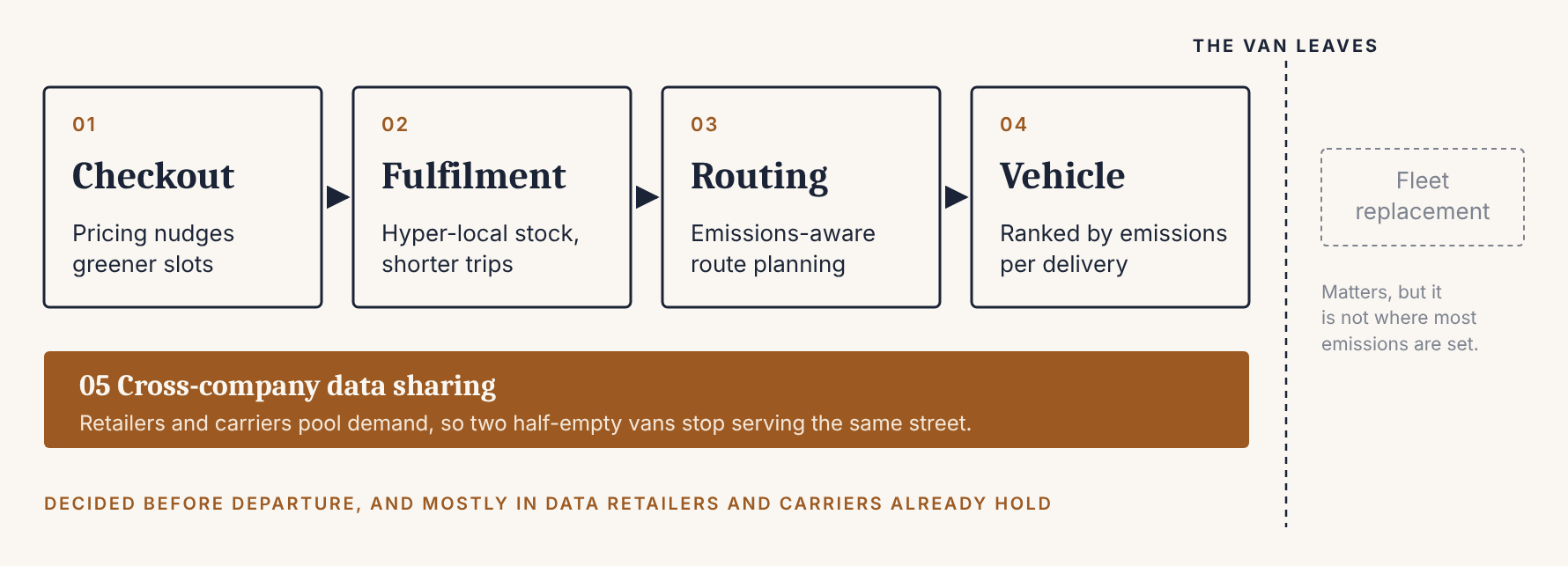
Using data as a strategic resource turns green delivery from an extra cost into an operational gain across four levers:
- Route and schedule optimisation. Combining vehicle sensors, GPS, transportation and warehouse management outputs, traffic, weather and delivery-density data reduces both distance driven and time on the road. Fewer miles per drop lowers fuel and energy consumption and cuts unit delivery cost at the same time.
- Hyper-localised fulfilment. Fulfilling an order from the nearest store, micro-hub or warehouse shortens the final leg, lowers inventory buffers and cuts transport cost. Doing it reliably requires linking sales volume by location, supplier transit times, storage capacity and local demand forecasts in one decision model.
- Measuring and ranking vehicles by actual emissions. Connected-vehicle telemetry and near-real-time emission data allow operators to rank every vehicle in the network by its actual emissions per route and prioritise the cleanest capacity first.
- Dynamic-pricing incentives at checkout. When checkout pricing reflects live route density and vehicle capacity, consumers can be rewarded for choosing a delivery window that consolidates trips into a single full-capacity run. The consumer pays less, the operator runs fuller vans and fewer trips, and emissions drop.
Why no single operator can solve it alone
A retailer, a carrier and a city each see only their own slice of the trip. When each company optimises its own fleet in isolation, five half-empty vans still drive down the same street in the same hour.
Avoiding that sub-optimisation requires data collaboration across companies through secure, governed APIs: sharing route density, hub capacity and emissions data without exposing commercial secrets. The hardest part is rarely the routing algorithm. It is data quality, reconciliation across disparate systems, and the commercial governance that gives every participant a reason to share.